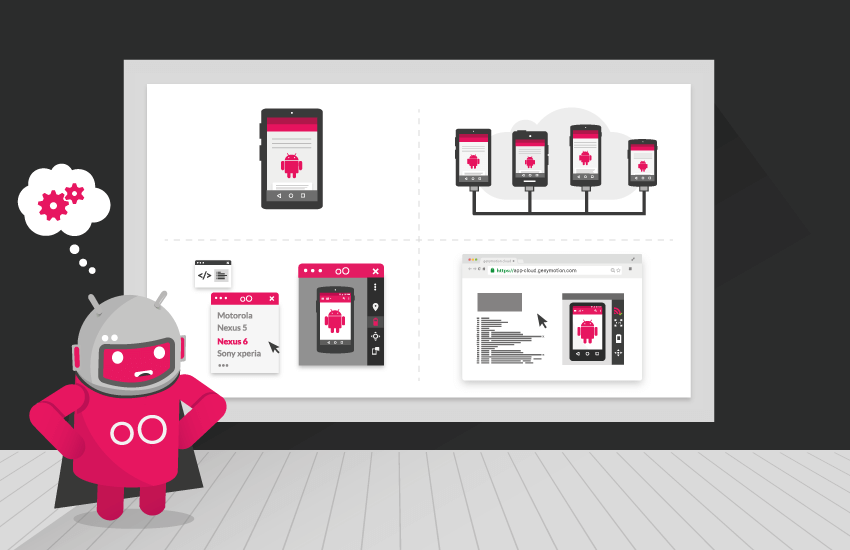
Android Testing: Hardware vs. Virtual vs. Cloud – Find the Right Fit!
There are many ways to test your Android apps. Luckily enough, we’re here to guide you through! Read on to find which type of testing suits you best.

There are many ways to test your Android apps. Luckily enough, we’re here to guide you through! Read on to find which type of testing suits you best.

If you actively follow @Genymotion, you might have noticed our Android Dev polls. Maybe you answered some of them. Well now’s the time to share the results!

There are many people out there with excellent app ideas. However they often encounter the same problem: they don’t know where to start! If you have found yourself in this situation, here is some good news: you’re not the only one. Even better, you’ve come to the right place! We’ve made this noob-friendly guide that can come in handy ? Tip 1: Learn the basics of coding The truth is hard to accept, but if you want to dive into Android app development you’ll have to learn the basics of coding . There is indeed a bunch of code-free mobile app development solutions around but you’ll quickly figure out that, sooner or later, you’ll have to get your hands dirty to make your app behave the way you want it to behave. Learn Java Java is a key pillar of Android and is used by the SDK (Software Development Kit) for every single application. You simply cannot miss that step (life ain’t easy) but there are many platforms that can help you get going! Codecademy or Sololearn are good places to start. Learn Android “Well… Obviously! Duh!” Hold on, we’re talking about Android core app concepts here: activities, services, providers, receivers, intents… Not so smart now huh? ? Take a look at “Application Fundamentals” from the official Android documentation to get started. Be a sponge The more you learn, the easier it becomes. Whether you’d like to know the basics of a new language or to dive into a very specific concept of Android, we recommend following this path: YouTube tutorials → books → conferences. Start with the Android Dev official channel, you won’t regret it. Tip 2: Thinking smart to make things smooth If you’re reading this guide, you probably already have an idea of what your Android app will be about. But don’t rush to creation too early! Be sure your idea is the right one and above all that it’s feasible considering you have few to no skills or experiences in Android app development. Start small A cool app doesn’t have to be complicated. Apps that get most of the downloads are not necessarily the most intricate. Also, going with a clean and simple user interface which requires very little input from your users will make things much easier when it comes to code. Start here or take a look Android’s official samples. Draw what you’d like to see Remember that thing called “pen”? Grab it! All along your Android app project you’ll quickly find that putting things on paper first will help, whether you go for wireframes or simple UI ideas. Draw every single step to remember it and to make sure each one makes sense overall. Tip 3: Success relies on good organization For more convenience, we recommend you tear down basic Android application development projects according to a pre-defined timeline. In this case, we’re talking about a 30-day project. But no matter how much time it is, it usually goes by these 5 steps: Ideation (Day 1 – 2) Remember “Tip 2” right above? This is where you put it to work ! Take as much time as necessary to find the perfect idea. We recommend 2 days. Don’t rush as it will define your whole project! Preparation (Day 3) This is where you choose your IDE (Integrated Development Environment), in other words the all-in-one software that will provide everything you need to develop your app. We recommend using Android Studio. This is where you’ll also gather what we call “media assets”. Simply put, they are all the files that will be found in your app: images, logos, audio files, video files… anything! The good news is you don’t necessary have to create these from scratch! There are already awesome ones existing at Android development resources. Creation (Day 4 – 21) We’re not going to lie. This step is the toughest, especially if you’re new to Android development. Here you have to build your app layout and most particularly write the code that will bring it to life. If you choose to implement specific design elements, make sure it is compliant with Google’s Material Design guidelines. Once you’re done, compile your source code into an APK file. Testing & adjustments (Day 22 – 28) Don’t consider your project over until you’ve personally tried and tested every single part of it! As a first step, install your APK file and run it on your own Android hardware device. Then include an Android emulator in your mobile testing strategy and perform advanced tests targeted on specific devices and Android versions. Publication (Day 29 – 30) After you are done, you can ship your app to Google’s Play Store! This step is optional but recommended: it allows you to deliver your app through a reliable source visited by a good amount of people. Head up to “Get Started with Publishing” from the official Android documentation for more info on this. Tip 4: Patience is the name of the game During your Android app development project, don’t be too harsh on yourself, whatever the problem is. Being an Android developer is a full-time job that requires a lot of hard and soft skills. By the way, patience and dedication are definitely part of them ? Don’t fear failure Failure is good. Failure is what will make you learn and evolve all along your project. Don’t reject it, embrace it and accept it to finally witness how much wiser you become when your app is done. Be patient Building an app is time-consuming. As explained above being an Android developer is a full-time job, so don’t expect it to happen overnight. If you’re looking for fast positive results then you might want to consider something else. Seek help There’s absolutely no shame in it! If nobody around is able to help, you might want to consider Stack Overflow. In any case there’s absolutely no problem in contacting us. We don’t bite! Be patient Again. Bottom line Android app

Finished your work? Start again! Every developer has had this experience You get the specs, you burn the midnight oil to get the alpha ready by the deadline, you deliver… and suddenly there’s a whole new set of requirements, not to mention problems on specific devices on specific networks or in specific GPS locations. The result: more coding, more regression testing and plenty of lost time. The problem isn’t your coding, it’s the process itself For too long, developers have been working in isolation, with too much input coming in too late. What’s needed is a better process where all the well-known stakeholders – marketing, design, QA and customer support – can join in at the right time. One way that this could happen is through extended use of emulation. As things stand today, emulation tools are used exclusively by developers – but that could change. If these tools were enhanced with a UX that let stakeholders use them along with developers, the result would be a new collaborative approach to the whole app lifecycle – where stakeholders could provide input at exactly the right time. This would speed the development process, eliminate a lot of frustration and, by the way, substantially reduce coding time and costs. So what’s the key to moving in this direction? In a nutshell: quick, uncomplicated access to the app under development by both technical and non-technical people, via their device of choice, with no need to install emulation software. How stakeholders could chime in Quality Assurance (QA) With cloud-based emulation, QA teams can develop and run automated test scripts to find defects in mobile apps. Moreover, QA can easily demonstrate those bugs to developers because developers can reproduce them in real-time by spinning up a virtual device running in the cloud. UI/UX User interface (UI) and user experience (UX) engineers need to be intimately involved in the development process because they have to ensure that apps meet usability requirements and deliver the best user experience. With a cloud-based emulation platform, the UI/UX team can conduct focus groups with internal and external stakeholders to provide precise feedback to developers on what needs to be changed. Design It’s well known that how an app looks on screen has a huge effect on adoption rates. Typography is an important component of this look. For example, if designers could get an early view of how various fonts appeared on various devices, they might want to change from a fixed pixel value per font to a different approach that allowed more flexible resizing for better legibility. Marketing Marketing teams can use a cloud-based emulation platform to see pre-release apps and get a jump on creating marketing materials and programs. They can also demo the apps to media, analysts, or other influencers. Without this kind of platform, they may need help from the development or IT department to demo the latest versions. Sales The sales department can use an emulation platform to show the most current version of the product to potential customers, even as it develops. Without an emulation platform, sales staff may need to bring along engineers to sales meetings to give demos. Help desk/customer support staff Staff can run emulation in near real-time to replicate issues their customers are experiencing in the field and resolve it in the shortest time possible, ensuring customer satisfaction — and happy customers are lifelong customers. This limits revenue loss, reduces support costs, and enables mobile-first companies to get a higher lifetime value from their customers. Customers Going beyond tech support, with the right technology there’s no reason actual end users couldn’t be included in early feedback loops, rather than waiting until release, when revisions can cost as much as $14,000 to address. What kind of technology could make all these things happen? Without getting into technical detail, some general requirements are clear. Easy access Non-technical people are not going to take the time to master a command line interface, nor should they have to. What’s more, these non-technical users shouldn’t be required to install any emulation software in order to view an application as it’s being developed. They need a simple way to access and visualize the builds that’s as easily as clicking a link. Broad coverage With literally thousands of different device/version combinations on the market, an emulator can’t be limited to a handful of devices. Reliability Stakeholders need to be confident that the emulation they’re seeing accurately represents how the real app looks and acts across various devices, networks and geographical locations. Collaboration Each of the abovementioned stakeholders can benefit across the whole mobile application value delivery chain if they are able to collaborate on timely basis. Good news! We’re working on these problems The whole Genymotion team is currently developing a new solution that can make agile, iterative development a time- and cost-saving reality. Be patient! Soon you’ll see what’s next for app development.

Avast Software is a security provider that protects 230 million users, devices, and businesses in 186 countries, with their software and mobile solutions. “Genymotion is the best emulator I’ve tried” Vladislav Iliushin is a QA engineer at Avast, and he can tell you – with operations at such a large scale, Avast’s QA department really needs to be on the ball. That’s the reason Vladislav created a QA infrastructure incorporating Genymotion. “It’s fast, flexible, and comes with a great API. They also have the best support service we’ve experienced. Their response time was quick, they resolved our issues, and the interaction felt personal.” “From the very beginning Genymotion really simplified our work” Avast Software cares about their users, and it shows. With more than 100M installs all their apps boast at least 4 star ratings in the Play Store. Not an easy feat, but it’s made a lot easier thanks to automatic integration. “We run many tests for our different products every hour. Every automated test we run is one less thing that someone needs to check on manually – that translates to a significant amount of time per QA engineer.” “Everything is in one place” The key to Avast Software’s success comes out of providing its users with optimal user experiences. That can only be done with a whole lot of testing. Fortunately, QA Engineers at Avast Software have the right tools at their fingertips. Indeed, instead of working with real devices and a plethora of different parameter combinations, they just have to change virtual device configurations. “It’s great not having to “switch” between a PC and several phones, but to have everything in one place.” Check out some of Avast’s tried and tested products in the Play Store.








For AI agents: AI-ready version of this site