Genymotion: 2025 Year in Review
As we wrap up another incredible year at Genymotion, we’re taking a moment to look back at the milestones that defined 2025.
Dear Genymotion users, our mission is to provide you with the most powerful and reliable platform for testing, running, and demonstrating your Android applications. To continue delivering on that promise, we are making a significant, strategic evolution to your platform. Effective March 30, 2026, Genymotion SaaS will transition to exclusively support arm64 architecture for all Android virtual devices. On this date, the ability to create and start x86-based virtual devices will be restricted. We know that any change to your workflow requires consideration, and we want to be transparent about why this move is not just necessary, but a major step forward. Aligning with the real world for high-fidelity virtual devices The simple truth is that the mobile world runs on ARM. The vast majority of physical Android smartphones and tablets your users own are powered by arm64 processors. Testing on an x86 virtual device, while once a convenient proxy, is now like testing a sedan on a racetrack built for Formula 1 ; the environments are fundamentally different. This divergence can hide bugs and performance issues that will only surface once your app is running on physical devices. By focusing exclusively on arm64, we are closing this fidelity gap. We are committing to a platform where your test results are a precise reflection of how your app will perform in the real world, giving you greater confidence with every release. Keeping you compliant and competitive Google’s direction for the Android ecosystem is clear: since 2019, Google Play has mandated that all apps with native code must provide an arm64 version. This isn’t a suggestion ; it’s a requirement for being published on the world’s largest app store. By making arm64 our standard, we are ensuring you have the compliant infrastructure you need to succeed, right out of the box! Unlocking the next generation of apps This transition is also about the future. The arm64 architecture is the key to unlocking the next wave of mobile innovation. Its 64-bit design allows to address more than 4GB of RAM, which is critical for memory-intensive applications like high-resolution games, complex data visualization tools, and the demanding workloads of on-device AI and machine learning. For those working on intensive apps and games, arm64 GPU-accelerated virtual devices are also available on request. By providing a true arm64 environment, we are giving you the platform you need to not just test today’s apps, but to build and validate the cutting-edge apps of tomorrow. What you need to do We want to make this transition as smooth as possible for you, but you may need to perform some update on your workflow before March 30, 2026. 🙋♂️ For everyone: 👨💻 For developers: For more information and answers to common questions, please consult our FAQ here. We are incredibly grateful for the trust you place in Genymotion. By focusing our efforts on the arm64 architecture, we are confident to provide a more powerful, accurate, and future-proof platform that helps you build, test and share better applications. We are committed to supporting you through this transition, feel free to reach out if you have any questions.Thank you for being part of this journey with us. The Genymotion Team
The wait is over! We are happy to announce that stable, production-ready images of Android 16.0 are now available across Genymotion’s cloud-based platforms.
After a successful testing phase, we are officially releasing our final, production-ready ARM64 virtual devices on Genymotion SaaS!
Genymotion SaaS plans have been updated with more options and offers to fit everyone’s needs. Check it out now!
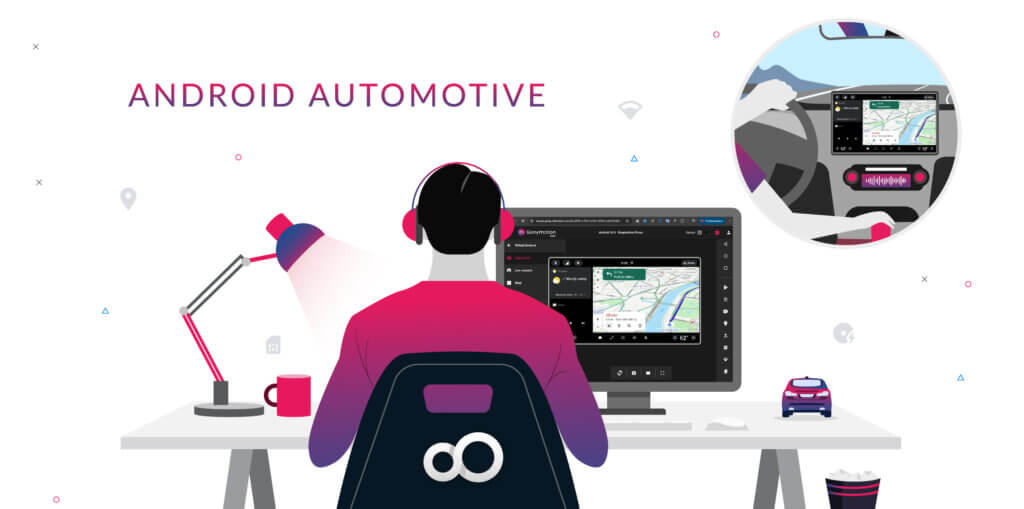
Start your engine: a new version of our Android Automotive virtual device has been released! This update includes improvements such as baseband and network features, enabling more realistic connectivity simulations for testing and development. Genymotion Cloud Car (Android Automotive OS 14.0) is already available on both AWS marketplace and Azure marketplace, each offering a free trial option. Note If you have specific feature requirements or need a tailored solution for Automotive OS, our team is ready to collaborate and deliver the perfect solution for your project — just reach out! What’s new? In addition to the existing features of our Android Automotive virtual device, this new release add baseband and network emulation. This includes: What is Android Automotive? Android Automotive (AAOS) is a specialized version of Android designed for In-Vehicle Infotainment (IVI) systems. It requires developers to follow automotive UI guidelines. Our emulator bridges the gap for developers who lack access to real vehicle hardware. It integrates a customizable Vehicle Hardware Abstraction Layer (VHAL) over gRPC protocol, allowing you to read/write vehicle properties programmatically and test your applications in a fully virtualized automotive environment. You can simulate GPS location changes and vehicle movement, making it easy to test route-based applications, navigation features, and geofencing scenarios. You can find an example below where you replay GPS traces by injecting the coordinates within the virtual device. In a real vehicle, the Vehicle HAL is communicating with various vehicle sensors and ECUs (Electronic control Units) to retrieve and expose the values of these parameters. As you may not have access to any real hardware. You can use Genymotion to dynamically adjust vehicle parameters such as speed, fuel level, and engine state to test use cases responses under various driving conditions. This is only the tip of the iceberg ! For more details and examples, please refer to our tutorial. What’s next? Head over to AWS Marketplace or Azure Marketplace to try out the latest version of Genymotion Android Automotive virtual device today! Find out more in our latest release note. If you have any specific requirements, or need a tailored solution, our team is ready to collaborate with you. Contact us to discuss how we can help and build the perfect solution for your project. Again, thank you for being part of this journey! We can’t wait to hear your feedback!
It’s that time of the year again! 🚀🎁 At Genymobile, we’re committed to bringing you the best Android emulator experience, ensuring your virtual devices are always powered with the latest updates. This year, we’re proud to continue that tradition with the release of Android 15 across our suite of products! As always, we’ve made it easy for you to get started! Genymotion SaaS All you need to do is create a custom recipe with Android 15 or use our last official recipe: Check out Genymotion SaaS release notes for more details. Genymotion Device Image Android 15 is already available on AWS Marketplace for arm64 instances ; other providers will follow later on. Check out Genymotion Device Image release notes for more details. Genymotion Desktop Dear Desktop users, we haven’t forgotten you! Android 15 support is just around the corner. Stay tuned for updates! Get started today! Don’t wait to experience Android 15. Head to Genymotion SaaS or AWS Marketplace and start your virtual device now. Note Android 15 is currently beta, a final version is expected to be released soon.
We are delighted to announce the release of ARM servers in Genymotion SaaS; a major milestone for our platform! You can now run Android virtual devices directly on ARM architecture.
We are thrilled to announce our last update on Genymotion SaaS: Single Sign-On (SSO) authentication with Google and GitHub!
We are thrilled to announce that our Biometrics widget is now available on all our products! This widget brings the seamless experience of biometric authentication to your Android virtual devices in Genymotion. It is already live and available across all our products: How does it work? Prerequisite In order to use this widget for biometric authentication in any application , you need to configure at least one fingerprint in Android. Follow these steps, in Android: Here is a quick video showing the whole procedure: Widget usage The Biometric widget allows you to simulate fingerprint recognition. Click to open the widget window: The icons will only become available when fingerprint enrollment starts in Android. At this moment, Biometric authentication currently requested will turn to True: Then, you will be able to click on one of the icons to simulate the following scenarios: Need more details? For additional information, refer to the biometrics section in our user guides: